Why Every AI Project Needs a Harness
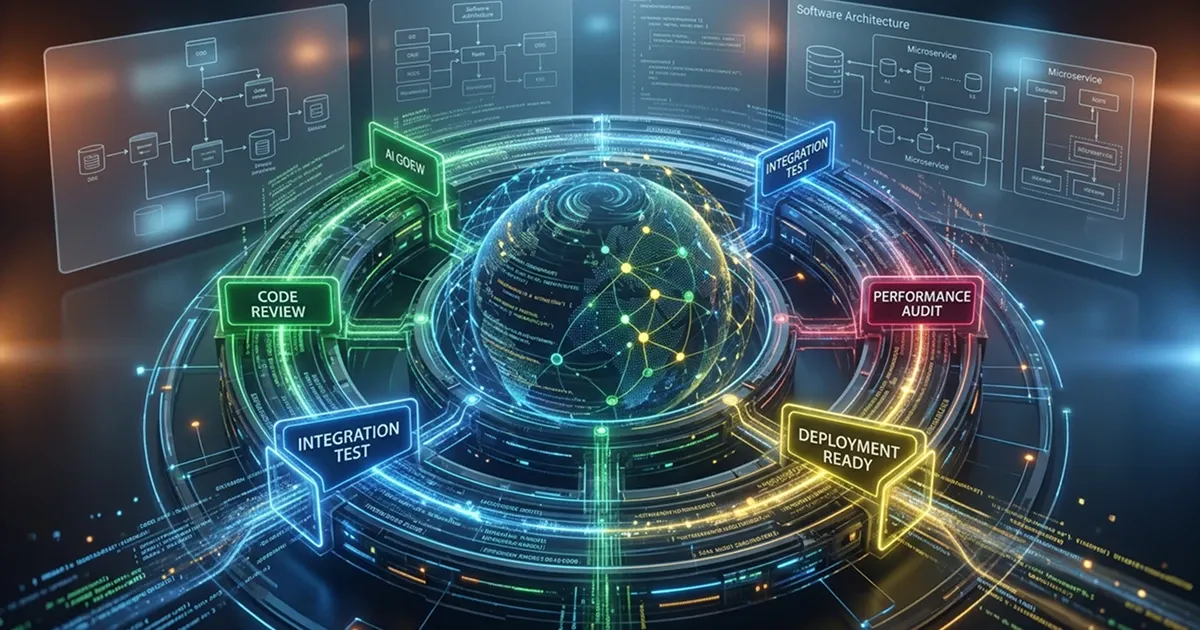
The biggest misconception about AI-assisted software development is that generating code is the difficult part.
A few years ago, writing thousands of lines of code required significant effort. Today, an LLM can produce a working prototype in minutes. The bottleneck has shifted.
The real challenge is no longer creating software. It's knowing whether the software still does what it's supposed to do after every change.
That's where a harness becomes essential.
The Problem: Faster Development, Faster Mistakes
Many teams are impressed by how quickly AI can generate new functionality. A developer writes a prompt, reviews the output, performs a few manual tests, and moves on.
Initially, this feels incredibly productive.
Until something breaks.
A small change affects another workflow. A new feature introduces an unexpected edge case. A prompt adjustment improves one area while silently degrading another.
Without a structured validation process, teams often operate on assumptions rather than evidence.
Ironically, AI doesn't just accelerate development. It also accelerates the rate at which mistakes can enter a system.
What Is a Harness?
A harness is a controlled evaluation environment that continuously verifies whether a system behaves as expected.
In traditional software development, this might include:
- Automated tests
- Integration tests
- Performance benchmarks
- Security checks
- Regression testing
For AI applications, the concept becomes even more important.
An AI harness may evaluate:
- Response quality
- Accuracy
- Hallucination rates
- Business rule compliance
- Prompt changes
- Model upgrades
- Cost efficiency
Instead of asking, "Does it seem to work?", a harness allows teams to ask, "Can we prove it works?"
That distinction is critical.
Why AI Makes Harnesses More Important Than Ever
Traditional applications are usually deterministic.
Given the same input, they should produce the same output every time.
AI systems behave differently.
Even minor prompt changes can influence responses. Switching from one model version to another may improve some use cases while degrading others. Small modifications can have surprisingly large consequences.
Without measurement, these changes are largely invisible.
Many organizations deploy AI solutions based on subjective impressions:
"The answers look better."
"It feels faster."
"The output seems more accurate."
None of these are engineering metrics.
A harness transforms opinions into measurable results.
The Business Impact
For many SMEs, software failures are not technical problems. They are business problems.
An incorrectly processed order. A misclassified document. An inaccurate recommendation. A failed integration.
All of these translate directly into wasted time, customer frustration, or lost revenue.
Yet many businesses invest heavily in AI capabilities while spending almost nothing on validation.
That is equivalent to buying a race car and removing the dashboard.
You may be moving faster, but you no longer know whether you're heading in the right direction.
A Practical Example
Imagine an internal AI assistant that helps employees process customer requests.
Version 1 achieves an accuracy rate of 85%.
After a prompt optimization, users report that responses feel more natural. The team deploys the update immediately.
Without a harness, everyone assumes the system improved.
With a harness, the team discovers:
- Accuracy dropped to 78%
- Processing costs increased by 30%
- Certain customer categories are now handled incorrectly
What looked like progress was actually a regression.
The harness prevented a costly mistake before it reached production.
The Most Valuable Feedback Loop in Modern Development
The best AI teams are not necessarily the ones building the fastest.
They are the ones learning the fastest.
A harness creates a continuous feedback loop:
Build → Evaluate → Measure → Improve → Repeat
Every iteration generates data.
Every improvement can be validated.
Every decision becomes evidence-based rather than opinion-based.
This dramatically reduces risk while allowing teams to innovate with confidence.
Conclusion
AI has reduced the cost of generating software.
It has not reduced the cost of being wrong.
In fact, because development cycles are becoming faster, the ability to validate changes has become more valuable than ever.
Organizations that treat AI as a code generation tool will certainly move faster.
Organizations that combine AI with a robust harness will move faster and make better decisions.
And in the long run, that difference is what separates experiments from sustainable software.